How Many Watches Should Your Watch Winder Hold?
A practical guide to choosing watch winder capacity: single, double, four-watch and larger winders, plus cases that combine winding and storage.
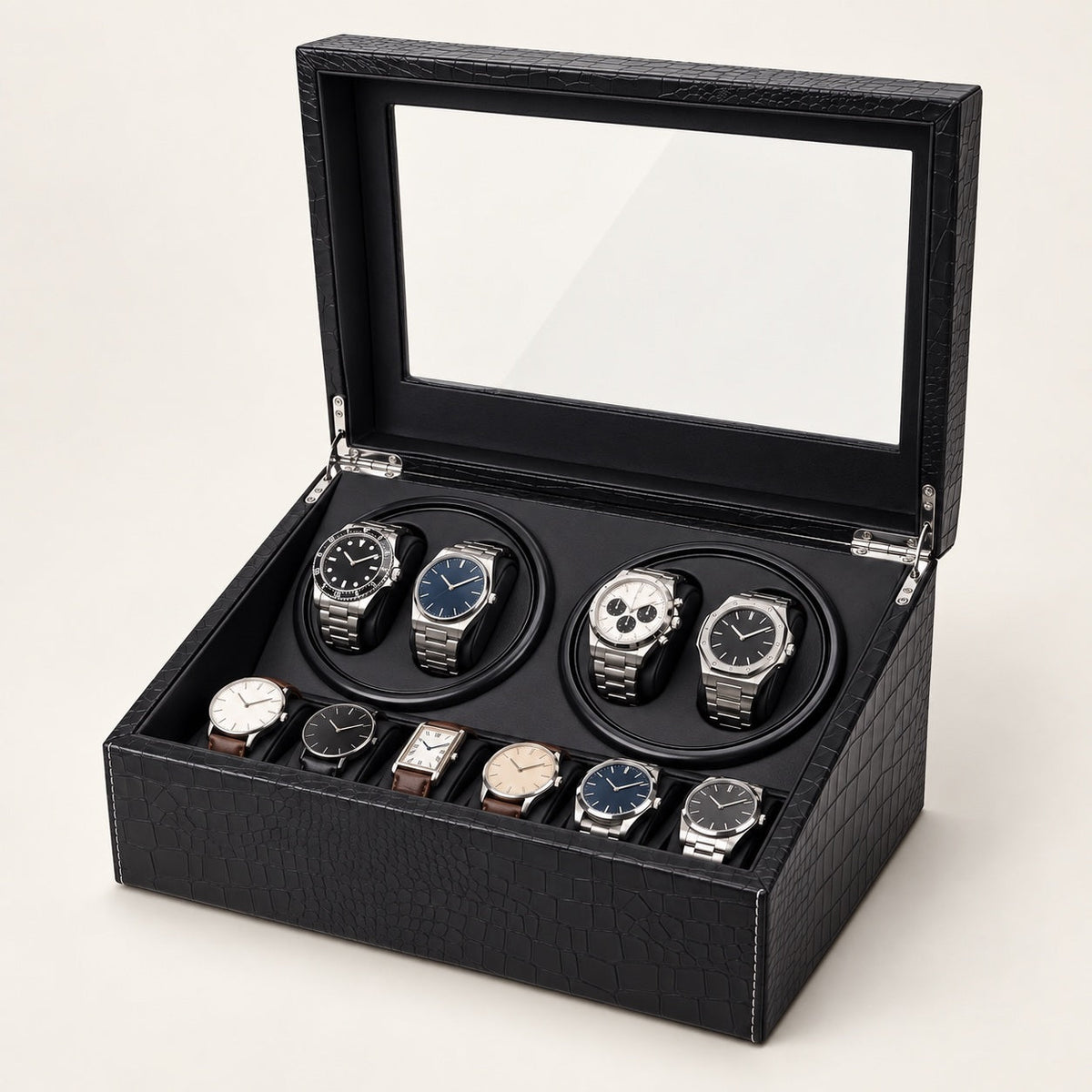
Watch winders are sold by the number of watches they turn: one, two, four, six or more. It is tempting to buy for the collection you might own one day, but the right capacity depends on something simpler: how many automatic watches you rotate and want ready to wear. This guide walks through the common sizes and what each one suits.
Start with the watches you actually rotate
A winder only helps automatic watches. Quartz and hand-wound pieces do not benefit, so leave them out of the count. Then think about which automatics you wear in a typical fortnight. A watch you wear once a year can usually be left to stop and be set again when you need it. A watch you wear every few days, or one with a date you dislike resetting, is a better candidate for a winding position.
If you are not yet sure whether a winder is worth it, our article What Is a Watch Winder? covers how they work and when they help.
One watch: a single winder
If you own one automatic, or one you reach for far more often than the others, a single winder keeps things simple and takes up little room. The options differ mainly in shape and settings. Form Slate (12 × 10 × 12 cm) and Orbit One (14 × 14 × 14 cm) are compact, and Nomad has an enclosed format. Ritual One has adjustable rotation programmes, Archive has a selectable winding direction and Orbit Silver has clockwise and anticlockwise settings. Facet One comes in six finishes.
Two watches: a pair in rotation
Many people alternate between two automatics, one for the office and one for the weekend. A two-position winder keeps both running. Ritual Duo and Orbit Duo each wind two watches. The Valet winds two and adds a lower drawer with space for two more watches that do not need winding.
Three or four watches: room to grow
Once a collection reaches three or four automatics, a four-position winder gives each one its own place. Form One is available with 1, 2 or 4 positions, so you can choose the size you need. Chamber has four winding positions, while Chamber Noir (four winding and six storage spaces) and Grand Ritual (four winding and five storage spaces) also keep your other watches in the same case.
A mixed collection: winding plus storage
Not every watch needs to turn. If you own a few automatics alongside quartz or hand-wound pieces, a combined case can be more practical than a large winder. Chamber Reserve has two winding spaces and eight storage spaces, and Regent Six has six winding spaces and seven storage spaces.
Six watches or more
For a larger collection of automatics, Regent is available with 2, 4, 6, 9 or 12 individual winding spaces. Check the dimensions on the product page for the size you choose: the 12-watch version measures 21.5 × 35 × 53 cm, so it needs a solid surface or a dedicated space in a cabinet.
Before you choose
- Count automatics only: quartz and hand-wound watches do not need a winding position.
- Check each movement: confirm the winding direction and turns per day recommended for every watch you plan to wind.
- Check the fit: the cushion should hold the watch securely without stretching the strap or bracelet.
- Plan the space: think about the power supply and where the winder will sit.
You can compare every model in our watch winder collection. For watches you would rather keep at rest, a watch box may be all you need; our guide on choosing a watch box explains what to look for.